
Superconductivity with repulsion: A variational approach, Laura Fanfarillo, Yifu Cao, Chandan Setty, Sergio Caprara, and P. J. Hirschfeld, Phys. Rev. B 112, 134519 (2025) – Published 17 October, 2025
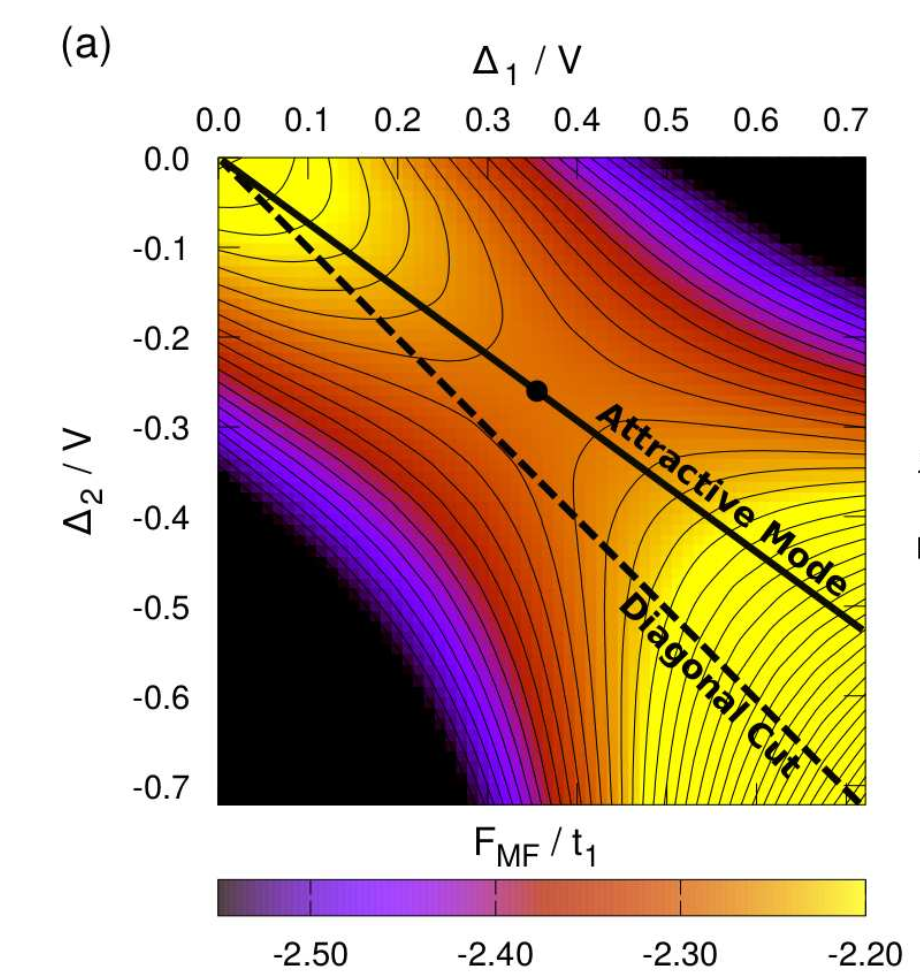
The figure illustrates, in a simple case, how diagonalizing only the interaction matrix fails to recover the correct definition of the system’s fluctuating modes. Diagonalizing the BCS kernel correctly identifies the attractive mode (solid line). In contrast, diagonalizing the interaction matrix yields an “attractive” mode along the dashed line, which not only does not coincide with the true attractive mode, but does not even contain the BCS solution. The colormap shows the value of the mean-field energy for which the BCS solution is indeed a saddle point.
Short popular summary from Laura Fanfarillo‘s blog
In conventional BCS theory, superconductivity arises when electrons attract each other: no attraction-no pairing. But multiband systems change the rules of the game.
In these systems, the band degree of freedom acts as a powerful ally. Even a purely repulsive interaction, if it acts between bands (interband), can lead to superconductivity. This idea sparked a lot of interest in the early days of iron-based superconductors, especially regarding how to define fluctuations and eigenmodes in such unconventional settings. (See our early contributions from 2009 and 2013)
More recently, this setting has revealed a subtle and somewhat paradoxical feature: while superconductivity clearly exists in these systems, certain mean-field treatments make the superconducting solution appear at a saddle point rather than a minimum of the mean-field free energy. This raised a conceptual puzzle: how can a physically stable state appear unstable in theory?
This apparent paradox sparked recent proposals to restore stability by projecting out repulsive modes, effectively restricting the problem to the attractive sector. However, this kind of projection is physically unjustified, as there is no underlying symmetry or dominant interaction that would naturally restrict the space of superconducting order parameters.
In our work, Superconductivity with repulsion: a variational approach, we address this problem at its root. By adopting Bogoliubov’s variational principle, we construct a consistent and physically meaningful free energy functional. Within this framework, the superconducting state is correctly identified as a true minimum, resolving the paradox and reaffirming the stability of superconductivity even in the presence of purely repulsive interband interactions.
We further discuss the relevance of considering the full BCS kernel, not just the interaction matrix, in correctly identifying the collective modes, and explicitly show how simplified treatments can lead to incorrect conclusions in model cases.
This work provides a robust and general framework for analyzing stability and fluctuations in multichannel superconductors. We’re proud that it was selected as an Editors’ Choice on Physical Review B, a recognition that highlights its clarity and pedagogical intent. We hope it will serve as a useful reference for those working on multiband superconductivity and related topics.

